A 78-Skill Offensive Toolkit for Claude Just Passed 6,700 Stars — Here Is the Governance Question It Raises
A GitHub repository called Claude-Red packages 78 offensive-security "skill" files across 23 categories — from common web-application bugs to advanced red-team tradecraft — as drop-in additions to Claude. It has passed 6,700 stars. Installing the files gives Claude the specialist context to act as a red-team operator for each technique. The project's own description names authorized engagements, bug-bounty work, research and training as its intended use — but, like most offensive tooling, it has no built-in mechanism that checks, scopes or logs authorization before a skill is used. That check is entirely on whoever installs it. The practical risk for an employer is not the repository itself; it is not knowing whether anyone in the org has quietly added it to their own Claude setup, unscoped and unlogged. Below: what the project is, why "authorized use" framing in a README is a policy statement and not a control, and a governance checklist for AI-assisted offensive tooling.
A GitHub project called Claude-Red (github.com/SnailSploit/claude-red) has passed 6,700 stars for a simple idea: package specialist offensive-security knowledge as drop-in "skill" files for Claude, so a session can act as a context-aware red-team operator instead of a general-purpose assistant. It is a clean illustration of something every security leader should already be tracking — AI assistants are becoming pluggable with domain expertise, and offensive security is one of the domains people are plugging in. This is not a walkthrough of the techniques. It is about the governance question the project raises for anyone running a security team.
What it is, at a level worth knowing
Claude-Red is a free, MIT-licensed collection of 78 "SKILL.md" files across 23 categories. Each file is a structured prompt — background, terminology, methodology — that gives Claude the specialist context to reason about a particular offensive technique the way a trained operator would, rather than giving a generic answer. The categories span the breadth of a red-team engagement: common web-application flaws, identity and lateral-movement attacks, cloud and container weaknesses, social-engineering and supply-chain tradecraft, and — at the advanced end — the kind of detection-evasion tradecraft that separates a script-kiddie exercise from a realistic adversary simulation. Installation is simple: clone the files into Claude's local skills directory, or paste them into a system prompt.
The part that matters: no built-in gate
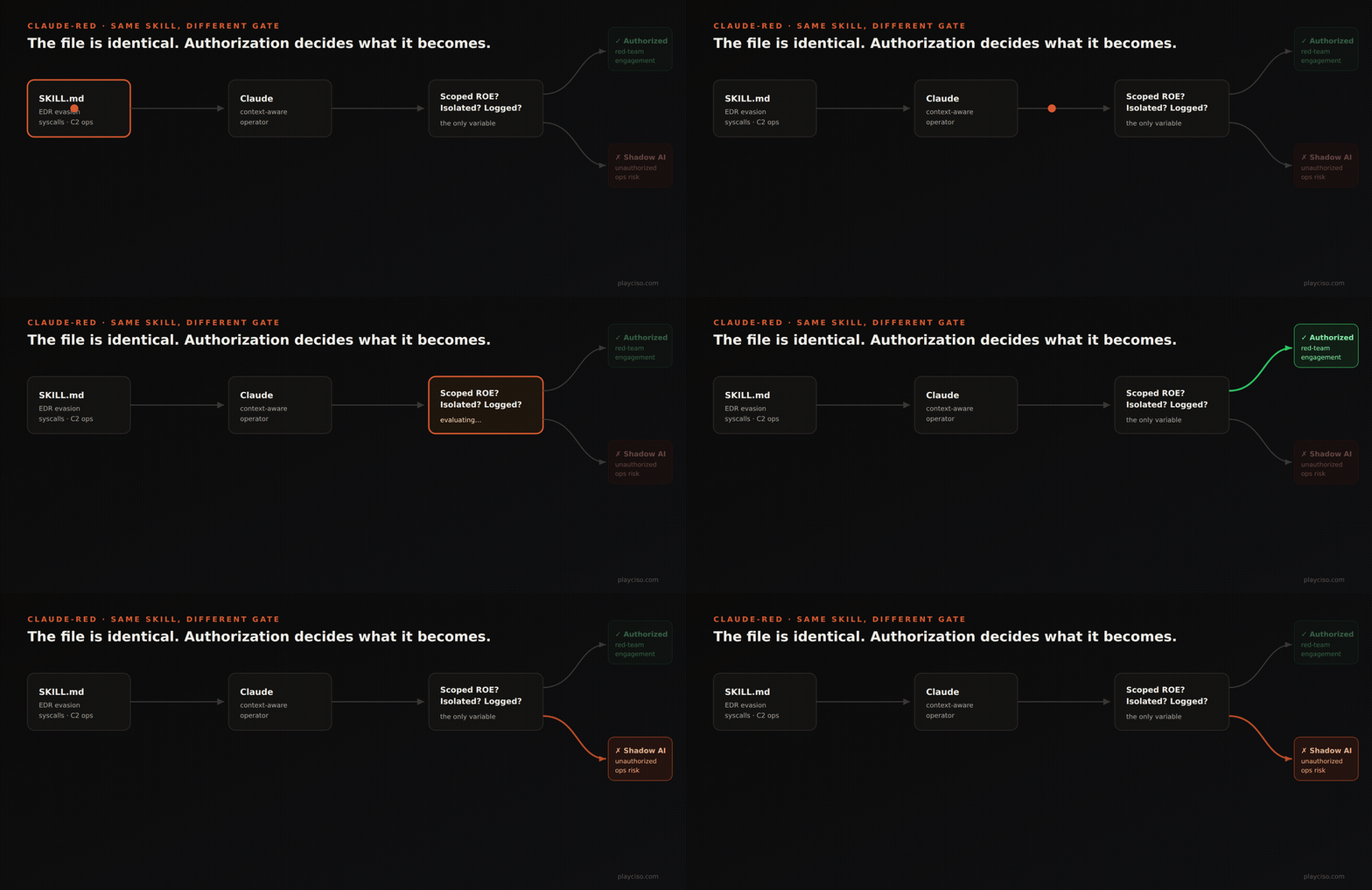
The project's own documentation names its intended use cases first — authorized engagements, bug-bounty triage, security research, CTF preparation, operator training. That framing is the right instinct. But naming an intended use in a README is a policy statement, not a control. Claude-Red ships no mechanism that verifies a signed rules-of-engagement exists, no scope check against a target, and no mandatory logging before a skill is invoked. Once the files are installed, any prompt in that session can draw on them.
This is not a criticism unique to Claude-Red — no general-purpose offensive framework enforces authorization at the tool level. Metasploit does not check your rules-of-engagement before firing an exploit module. Cobalt Strike does not verify you have a signed statement of work. The authorization boundary has always lived in process, not in the software. What is new is who can now operate at this level: a skill pack that gives Claude the context to reason like a specialist lowers the expertise bar for using advanced tradecraft, and an AI assistant is far more likely than a standalone offensive framework to already be sitting on an employee's everyday laptop, next to their regular work.
Why this is a shadow-AI problem before it is anything else
The realistic risk for most organizations is not a security team consciously deciding to run authorized red-team tooling — that already goes through a process. It is the version nobody signed off on: an individual engineer or analyst, curious or trying to move faster on an authorized task, drops a skill pack like this into their own local Claude setup. No scope document, no isolation, no session logging, and no one else in the org aware it happened. That is the same shadow-AI pattern security teams already worry about with unsanctioned SaaS AI tools and unmanaged MCP servers — except here the "unsanctioned tool" comes with specialist offensive tradecraft attached.
A governance checklist for AI-assisted offensive tooling
- Inventory first. Do you know whether anyone on your team has added an offensive-capability skill pack, plugin or MCP server to their AI assistant? Most orgs cannot answer this today. Start there.
- Named owner and signed scope. Any session with offensive skills loaded should map to a specific, authorized engagement with a rules-of-engagement document — the same bar you'd apply before anyone opens Metasploit.
- Isolation. Run it in an environment with no route to production and no access to real credentials — a disposable lab, not a daily-driver laptop.
- Full session logging. If the skill pack itself doesn't log, the environment around it should — every prompt and action, retained for the engagement record.
- Treat the skill files as a supply chain. Community-authored prompt files can carry more than they advertise. Review them before installing, the same way you'd review a new dependency.
- Policy, not just a memo. State plainly that offensive-capability AI tooling requires the same authorization as any other offensive tool, and that unsanctioned use is a policy violation, not a grey area.
The takeaway
Claude-Red is worth knowing about regardless of whether your team ever installs it, because it is a clean preview of a trend that is not going away: specialist domain packs, offensive security included, are becoming a normal way people extend AI assistants. The tool itself is dual-use and, used under real authorization, a legitimate accelerant for red teams and researchers. The governance gap is not a flaw in this specific project — it is the same gap that exists across offensive tooling generally, just arriving inside the AI assistant your engineers already trust. Close it with visibility and process, not by hoping no one installs the next one.
PlayCISO is not affiliated with Claude-Red or its author. This article is an independent overview based on the project's public README; features may change. This is a governance and awareness piece, not a technique walkthrough — it deliberately does not enumerate or explain the specific techniques the skill files contain. Offensive-security techniques should only ever be used with explicit, documented authorization.
Ready to practise the decisions these articles describe?
Run a free War Room →